
Hardwood
Abura
Abura (Mitragyna ledermannii) is a pale brown, fine-textured hardwood from tropical West and Central Africa, used for interior joinery, furniture, flooring and veneer. This guide covers its Janka hardness, weight, shrinkage, rot resistance, workability and common uses.
Photo: CIRAD
Specs
Wood Name
Abura
Common Name(s)
Abura, bahia, subaha (Ghana), mboi (Sierra Leone), elolom (Cameroon), mivuko (Angola), vuku (Congo), elelom nzam (Gabon)
Scientific Name
Mitragyna ledermannii (also written Hallea ledermannii, Fleroya ledermannii or Mitragyna ciliata). Lumber sold as abura often includes a close relative, Mitragyna stipulosa.
Wood Type
Hardwood
Distribution
Tropical West and Central Africa. Mitragyna ledermannii grows from Guinea and Liberia east to the Central African Republic. It reaches south to Gabon, the Democratic Republic of the Congo and Cabinda (Angola). The tree grows in freshwater swamps in rain forest. Its relative Mitragyna stipulosa has a wider range, from Senegal east to Uganda and south to Zambia and Angola.
Tree Size
Often 100 ft (30 m) tall or more, and up to about 115 ft (35 m). The straight trunk is usually free of branches for about 60 to 65 ft (20 m). It measures about 3 to 5 ft (90 to 150 cm) across and normally has no buttresses.
Average Dried Weight
34 lbs/ft³ (545 kg/m³), air-dry. Other sources list 35.6 to 37.5 lbs/ft³ (570 to 600 kg/m³) at 12% MC.Source: USDA Tropical Timbers of the World (AH-607), air-dry; ITTO and CIRAD for the 12% MC range
Specific Gravity (Basic, 12% MC)
Basic: 0.45 (oven-dry weight, green volume), and one other source lists 0.52. At 12% MC on an oven-dry weight basis: not confirmed, since no source we found gives it. Air-dry density (weight and volume both at 12% MC) is 0.57 to 0.60 g/cm³.Source: USDA Tropical Timbers of the World (AH-607) for 0.45; ITTO for 0.52 and air-dry density
Janka Hardness
780 lbf (3,470 N), side hardness, dry wood.Source: USDA Tropical Timbers of the World (AH-607), dry side hardness
Modulus of Rupture
12,100 psi (83.4 MPa) at 12% MC.Source: USDA Tropical Timbers of the World (AH-607), at 12% MC
Elastic Modulus
1,350,000 psi (9,310 MPa) at 12% MC. Other sources range from about 1,020,000 to 1,600,000 psi (7,050 to 11,020 MPa).Source: USDA Tropical Timbers of the World (AH-607), at 12% MC; CIRAD, ITTO and PROTA for the range
Crushing Strength
6,740 psi (46.5 MPa), parallel to grain, at 12% MC.Source: USDA Tropical Timbers of the World (AH-607), parallel to grain, at 12% MC
Shrinkage
Green to oven-dry, as a share of the green size: radial 4.1%, tangential 9.0%, volumetric 12.0%. The tangential to radial ratio is about 2.2. The wood moves only a little in use.Source: USDA Tropical Timbers of the World (AH-607), green to oven-dry, as a share of green size
Description
Color/Appearance
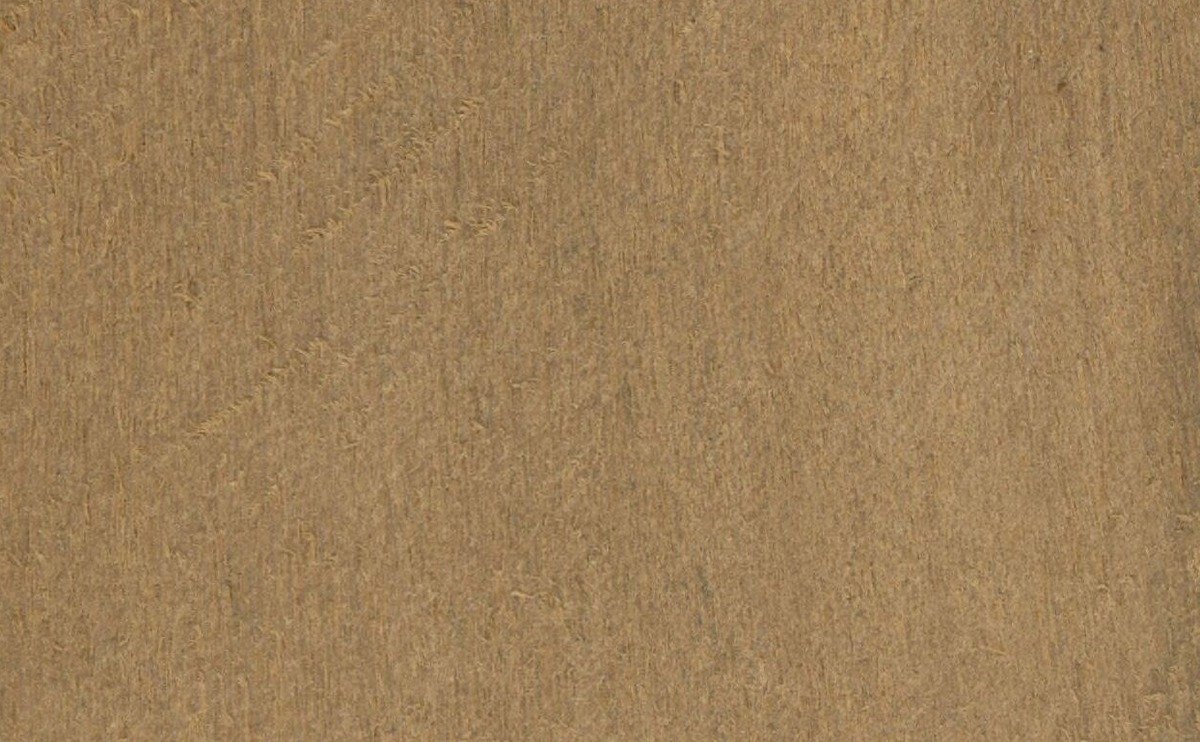
The heartwood is an even pale brown with a yellow, pink or gray tint. The wide sapwood usually blends into the heartwood with no clear line. Some logs show dark gum streaks or a brittle, spongy heart.
Grain/Texture
The texture is fine and even. The grain runs straight to slightly interlocked. The surface has little shine.
Rot Resistance
Low. The heartwood is not durable, and decay fungi, termites and dry-wood borers all attack it. On the European EN 350 scale, it sits in class 5, the lowest class. Use it indoors, and treat it with preservative if it will get damp. On the plus side, it holds up well against acids.
Workability
Abura works easily with hand and machine tools. It dries quickly with little warping. Silica in some boards dulls blades, so use carbide cutters and stellite-tipped saw teeth. It planes, sands and glues well, and it takes a good polish. Drill pilot holes before you nail or screw it. The wood is brittle and does not steam-bend well.
Odor
Freshly cut boards have an unpleasant smell.
Allergies/Toxicity
Abura sawdust can be an irritant. Workers have reported nausea, sore eyes and dizziness. Health agencies treat all wood dust as a hazard. The International Agency for Research on Cancer (IARC) classes wood dust as carcinogenic to humans, with links to cancers of the nose and sinuses. Wear a dust mask, use dust collection and keep skin covered when you sand or saw it.
Pricing/Availability
Abura is a general-purpose African hardwood sold mainly as lumber, plywood and veneer under the names abura and bahia. We have not confirmed its supply or price tier in North America.
Sustainability
CITES does not list this species. The IUCN Red List rates Mitragyna ledermannii as Near Threatened (criteria A2cd, assessed October 1, 2020, population decreasing). It was rated Vulnerable in 1998. Mitragyna stipulosa, which is sold under the same name, is also Near Threatened. The Red List names logging and clearing land for crops as the threats.
Common Uses
Interior joinery and trim, furniture, flooring, light indoor construction, plywood and veneer, toys, musical instruments, tool handles, carving, boxes and crates.
Sources
- Chudnoff, M. 1984. Tropical Timbers of the World, USDA Agriculture Handbook 607 (Mitragyna ciliata, Abura), research.fs.usda.gov
- CIRAD Tropix, Abura technical sheet (2026 edition), tropix.cirad.fr
- ITTO Tropical Timber lesser used species database, Abura/Bahia (Hallea ciliata), tropicaltimber.info
- ITTO Tropical Timber lesser used species database, Abura/Bahia (Hallea stipulosa), tropicaltimber.info
- PROTA, Mitragyna ledermannii (Nyemb 2011), plantuse.plantnet.org
- PROTA, Mitragyna stipulosa, plantuse.plantnet.org
- IUCN Red List, Mitragyna ledermannii, iucnredlist.org
- IUCN Red List, Mitragyna stipulosa, iucnredlist.org
- CITES Appendices I, II and III, cites.org
- CCOHS, Wood Dust: Health Effects (revised 2023-03-28), ccohs.ca
- CDC NIOSH Pocket Guide to Chemical Hazards, Wood dust, cdc.gov
Photos
Wood sample