
Hardwood
West African Albizia
West African albizia (Albizia ferruginea) is a yellow to red brown, coarse-textured hardwood from tropical Africa, used for furniture, joinery, flooring and veneer. This guide covers its Janka hardness, weight, shrinkage, rot resistance, workability and common uses.
Photo: CIRAD
Specs
Wood Name
West African Albizia
Common Name(s)
West African albizia, iatandza (Gabon), awiemfosamina (Ghana), musase (Liberia), kambala escura (Portuguese)
Scientific Name
Albizia ferruginea (Guill. & Perr.) Benth.
Wood Type
Hardwood
Distribution
Albizia ferruginea is widespread in tropical Africa. It ranges from Senegal east to Uganda and south to northern Angola. It grows in lowland and semi-deciduous forest, up to about 4,000 ft (1,220 m) elevation.
Tree Size
The tree is large and deciduous. It reaches 148 ft (45 m) and sometimes 164 ft (50 m). The clear trunk is up to 72 ft (22 m) long and sometimes 98 ft (30 m). The trunk is up to 3.3 ft (100 cm) across and sometimes 4.3 ft (130 cm). Some trees have small, thick buttresses up to 5 ft (1.5 m) high.
Average Dried Weight
PROTA lists 31.2 to 43.7 lbs/ft³ (500 to 700 kg/m³) at 12% MC, with some wood up to 51.2 lbs/ft³ (820 kg/m³).Source: PROTA, at 12% MC
Specific Gravity (Basic, 12% MC)
CIRAD lists 0.60 at 12% MC. The basic value (green volume) is Not confirmed.Source: CIRAD
Janka Hardness
PROTA lists a side hardness of 870 to 1,260 lbf (3,870 to 5,600 N) and an end hardness of 1,080 to 1,520 lbf (4,800 to 6,760 N), both at 12% MC.Source: PROTA, at 12% MC
Modulus of Rupture
The bending strength is 9,430 to 16,530 psi (65 to 114 MPa) at 12% MC in the PROTA data. CIRAD lists 11,750 psi (81 MPa).Source: PROTA, at 12% MC; CIRAD
Elastic Modulus
The stiffness is 1,334,000 to 2,103,000 psi (9,200 to 14,500 MPa) at 12% MC in the PROTA data. CIRAD lists 1,885,000 psi (13,000 MPa).Source: PROTA, at 12% MC; CIRAD
Crushing Strength
The crushing strength parallel to grain is 5,950 to 9,430 psi (41 to 65 MPa) at 12% MC in the PROTA data. CIRAD lists 7,250 psi (50 MPa).Source: PROTA, at 12% MC; CIRAD
Shrinkage
Green to oven-dry, PROTA lists 2.2 to 3.5% radial and 4.6 to 5.4% tangential. CIRAD lists 2.8% radial and 4.9% tangential, a ratio of 1.8. The wood dries slowly with little damage and stays stable once dry.Source: PROTA, green to oven-dry; CIRAD
Description
Color/Appearance
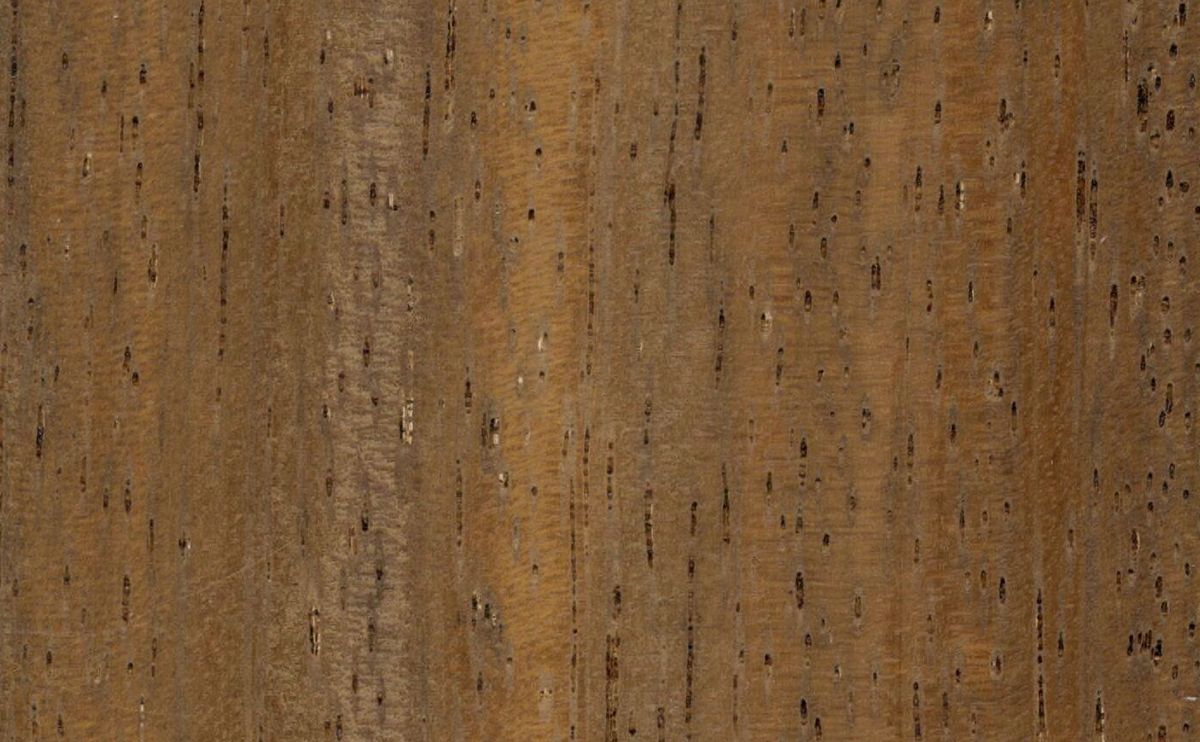
The heartwood is yellow brown to red brown with a golden, and sometimes purplish, shine. The sapwood is pale yellow to pinkish brown and 1.2 to 2.8 in (3 to 7 cm) wide. Radial faces show a pleasing figure.
Grain/Texture
The grain is interlocked, and CIRAD calls it slightly interlocked. The texture is coarse.
Rot Resistance
The heartwood is durable. CIRAD rates it class 2 on the European EN 350 scale, where class 1 is the best. It resists fungi, dry-wood borers and usually termites, though PROTA says wood from Liberia can be attacked by termites. The heartwood resists preservatives, while the sapwood takes them.
Workability
The wood saws and works easily with ordinary tools, and the effort depends on density. Use a small cutting angle to avoid tearing, and use a filler for a good finish. It holds nails and screws well, but pre-drill to prevent splitting. Gluing, steam bending and veneering all go well.
Odor
Not confirmed
Allergies/Toxicity
PROTA says the dust can irritate the nose and throat. Health agencies treat all wood dust as a hazard, and it can irritate the nose, throat and skin. Wear a dust mask and use dust collection when you cut or sand it.
Pricing/Availability
PROTA calls it a lesser-used timber with some place in international trade, often mixed with other Albizia species. CIRAD names France and the United Kingdom as the main importers. Ghana exported 240 m³ of sawn albizia timber in the first half of 2004. North American supply and price tier are Not confirmed.
Sustainability
IUCN rates Albizia ferruginea as Near Threatened (criteria A2cd, assessed January 30, 2020) with a decreasing population. An older 1998 assessment rated it Vulnerable. CIRAD says it is not listed in the CITES Appendices (2025 list).
Common Uses
The wood is used for construction, flooring, stairs, furniture, cabinets, joinery and turning. It also makes tool handles, carvings, glued laminated timber and veneer. Other uses include vehicle bodies, mine props, toys, musical instruments, railway sleepers, boxes and crates. In parts of DR Congo it is burned for charcoal.
Sources
- PROTA, Albizia ferruginea (Twum-Ampofo 2007), plantuse.plantnet.org
- CIRAD Tropix, Iatandza technical sheet (2026 edition, English; covers Albizia ferruginea and related species), tropix.cirad.fr
- IUCN Red List, Albizia ferruginea (Hills and Doucet 2021, assessed 2020), iucnredlist.org
- IUCN Red List, Albizia ferruginea (Hawthorne 1998), iucnredlist.org
- CCOHS, Wood Dust – Health Effects (revised March 28, 2023), ccohs.ca
Photos
Wood sample