
Hardwood
Amboyna
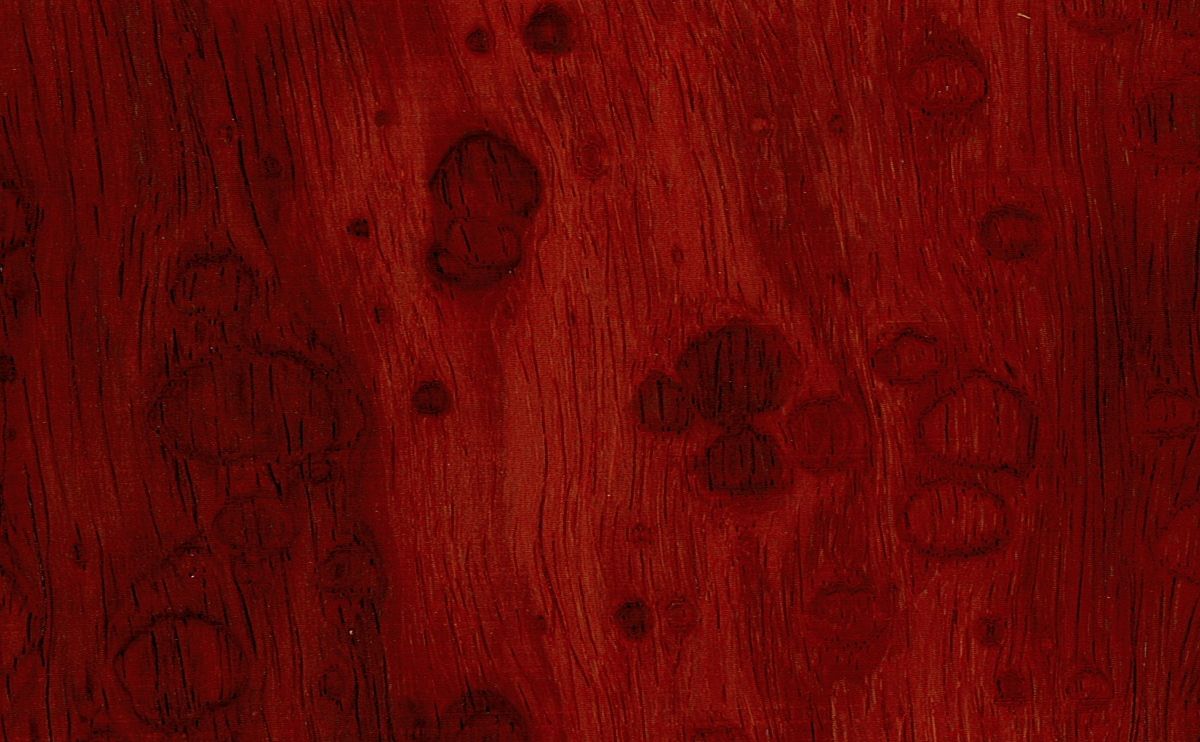
Amboyna (Pterocarpus indicus) is a red to honey colored, richly figured burl wood from Southeast Asia and the Pacific, used for veneer, turned objects and fine furniture. This guide covers its Janka hardness, weight, shrinkage, rot resistance, workability and common uses.
Photo: Friedrich Böhringer
Specs
Wood Name
Amboyna (narra burl)
Common Name(s)
Amboyna, amboyna burl, narra burl, amboina (Indonesia), padauk amboina (UK trade name)
Scientific Name
Pterocarpus indicus Willd.
Wood Type
Hardwood
Distribution
Amboyna is a burl cut from a tree, not a separate species. Most of it comes from narra (Pterocarpus indicus), which grows from southern Myanmar through Southeast Asia to the Pacific islands. IUCN counts it as native across much of China, India and Southeast Asia, and reports it lost from Viet Nam and Sri Lanka. Sellers sometimes label burl from a related padauk, Pterocarpus macrocarpus, as amboyna.
Tree Size
PROSEA describes narra as a medium to large tree up to 131 ft (40 m) tall. The bole is often massive in old trees, up to 138 in (350 cm) across, and usually has buttresses. Burl size is Not confirmed. Dealers sell it mainly as veneer and small blanks.
Average Dried Weight
The weight, hardness, strength, shrinkage and rot figures on this page were measured on solid narra (Pterocarpus indicus), not on burl, and burl values are Not confirmed. For narra, CIRAD lists 43.7 lbs/ft³ (700 kg/m³) at 12% MC. PROSEA gives a wider range of 34.3 to 56.2 lbs/ft³ (550 to 900 kg/m³) at 15% MC.Source: CIRAD; PROSEA
Specific Gravity (Basic, 12% MC)
Not confirmed for burl. CIRAD lists 0.70 for narra, using weight and volume at 12% MC. The basic value (green volume) is Not confirmed.Source: CIRAD
Janka Hardness
Not confirmed for burl. The Wood Database lists 1,260 lbf (5,620 N) for narra, the parent wood. CIRAD gives no Janka figure for it.Source: CIRAD; The Wood Database
Modulus of Rupture
Sources give a range of 11,890 to 13,970 psi (82 to 96.3 MPa) for narra at 12% MC. CIRAD lists 11,890 psi (82 MPa) and The Wood Database lists 13,970 psi (96.3 MPa). Burl values are Not confirmed.Source: CIRAD; The Wood Database
Elastic Modulus
Sources give a range of 1,724,000 to 2,408,000 psi (11,890 to 16,600 MPa) for narra at 12% MC. CIRAD lists 2,408,000 psi (16,600 MPa) and The Wood Database lists 1,724,000 psi (11,890 MPa). Burl values are Not confirmed.Source: CIRAD; The Wood Database
Crushing Strength
Sources give a range of 7,400 to 8,270 psi (51 to 57.0 MPa) parallel to grain at 12% MC. CIRAD lists 7,400 psi (51 MPa) and The Wood Database lists 8,270 psi (57.0 MPa). Burl values are Not confirmed.Source: CIRAD; The Wood Database
Shrinkage
Green to oven-dry, CIRAD lists 2.8% radial and 4.0% tangential for narra, a ratio of 1.4. The Wood Database adds 6.9% by volume. Burl figures are Not confirmed.Source: CIRAD; The Wood Database
Description
Color/Appearance
CIRAD describes narra sapwood as pale straw. The heartwood is deep blood red with near black markings, or honey colored with reddish black markings, and it darkens to dark brown. Burl pieces add dense swirls and knot-like clusters, and can show sharply contrasting pale sapwood.
Grain/Texture
Narra has straight to markedly interlocked grain and a coarse, lustrous texture. CIRAD says burrs carry dark markings and a wavy parenchyma structure, which makes them especially decorative.
Rot Resistance
CIRAD rates narra heartwood very durable (class 1) against fungi, and durable against dry-wood borers and termites. Risk is limited to the sapwood. These ratings describe solid narra. Burl durability is Not confirmed.
Workability
CIRAD reports a fairly high blunting effect from latex and resin deposits. It suggests stellite-tipped saw teeth, tungsten carbide cutters and pre-boring for nails and screws. Peeling and slicing go well. The Wood Database says narra turns, glues and finishes well.
Odor
CIRAD notes a rose scent. The Wood Database says the fragrance lingers after the wood is worked.
Allergies/Toxicity
The Wood Database says narra has been reported as an irritant, mostly to the skin and airways. Health agencies treat all wood dust as a hazard, and it can irritate the nose, throat and skin. Wear a dust mask and use dust collection when you cut or sand it.
Pricing/Availability
Amboyna ranks among the costliest and most sought-after burls. Suppliers sell it mainly as veneer and small turning or craft blanks. Some grade it as red or golden amboyna by color. CIRAD names the United Kingdom as the main importer of padauk amboina.
Sustainability
IUCN rates Pterocarpus indicus as Endangered (criteria A3cd+4cd, assessed January 10, 2018) because of heavy logging for rosewood timber. The CITES Appendices valid from March 5, 2026 list only African Pterocarpus populations, so this Asian tree is not covered.
Common Uses
Amboyna goes into fine furniture, veneer, turned objects, guitar tops and knife or gun grips. Solid narra also serves for cabinetwork, decking, flooring, stairs, musical instruments and boat building.
Sources
- CIRAD Tropix, Padauk amboina technical sheet (2026 edition; covers Pterocarpus indicus and P. dalbergioides), tropix.cirad.fr
- PROSEA, Pterocarpus indicus (Pl@ntUse), plantuse.plantnet.org
- IUCN Red List, Pterocarpus indicus (Barstow 2018), iucnredlist.org
- The Wood Database, amboyna page (secondary reference, used for cross-checks and gaps), wood-database.com and its narra page, wood-database.com
- CITES Appendices I, II and III valid from March 5, 2026, cites.org
- CCOHS, Wood Dust – Health Effects (revised March 28, 2023), ccohs.ca
Photos
Veneer face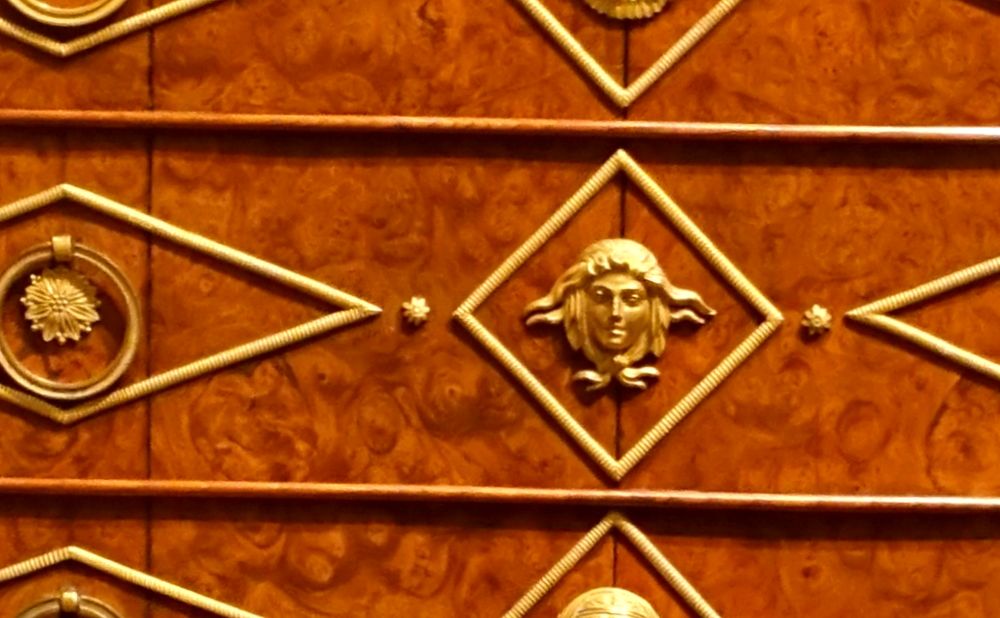 Burl veneer drawer fronts