
Hardwood
Anigre
Anigre (Pouteria altissima) is a creamy white to pale pinkish brown, fine-textured hardwood from tropical Africa, used mostly for veneer, furniture, joinery and molding. This guide covers its Janka hardness, weight, shrinkage, rot resistance, workability and common uses.
Photo: Philipp Zinger
Specs
Wood Name
Anigre
Common Name(s)
Anigre, aningeria, aniégré, aniguéri (Côte d’Ivoire), asanfena (Ghana), mukangu (Kenya), osan (Uganda)
Scientific Name
Pouteria altissima (A.Chev.) Baehni (synonym Aningeria altissima)
Wood Type
Hardwood
Distribution
Anigre grows from Guinea east to southwestern Ethiopia and western Kenya, then south to northwestern Tanzania and northern Zambia. It favors the drier parts of semi-deciduous forest. In Uganda it is common, and in places it dominates rainforest between 3,300 and 5,600 ft (1,000 to 1,700 m).
Tree Size
PROTA describes a large tree up to 148 ft (45 m), sometimes 164 ft (50 m). The straight bole is up to 79 in (200 cm) across, sometimes 98 in (250 cm), and clear for up to 98 ft (30 m). Buttresses reach 10 ft (3 m).
Average Dried Weight
PROTA lists 31.2 to 36.2 lbs/ft³ (500 to 580 kg/m³) at 12% MC. CIRAD lists 35.6 lbs/ft³ (570 kg/m³). The Wood Database lists 34.3 lbs/ft³ (550 kg/m³).Source: CIRAD; PROTA; The Wood Database
Specific Gravity (Basic, 12% MC)
CIRAD lists 0.57 at 12% MC (weight and volume at 12%). The Wood Database lists 0.44 basic and 0.55 at 12% MC. PROTA gives density only.Source: CIRAD; PROTA; The Wood Database
Janka Hardness
PROTA lists a side hardness of 1,250 lbf (5,560 N) and an end hardness of 850 lbf (3,780 N) at 12% MC. The Wood Database lists a much lower 990 lbf (4,380 N).Source: PROTA; The Wood Database
Modulus of Rupture
PROTA lists 13,050 psi (90 MPa) at 12% MC. CIRAD lists 12,180 psi (84 MPa). The Wood Database lists 12,040 psi (83.0 MPa).Source: CIRAD; PROTA; The Wood Database
Elastic Modulus
CIRAD lists 1,986,000 psi (13,690 MPa) at 12% MC. The Wood Database lists a lower 1,588,000 psi (10,950 MPa).Source: CIRAD; The Wood Database
Crushing Strength
PROTA and CIRAD both list 6,960 psi (48 MPa) parallel to grain at 12% MC. The Wood Database lists 6,920 psi (47.7 MPa).Source: CIRAD; PROTA; The Wood Database
Shrinkage
Green to oven-dry, CIRAD lists 3.7% radial and 7.0% tangential, a ratio of 1.9. The Wood Database lists 3.8% radial, 7.0% tangential, 11.8% by volume and a ratio of 1.8. PROTA calls the shrinkage moderate and the dry wood moderately stable.Source: CIRAD; PROTA; The Wood Database
Description
Color/Appearance
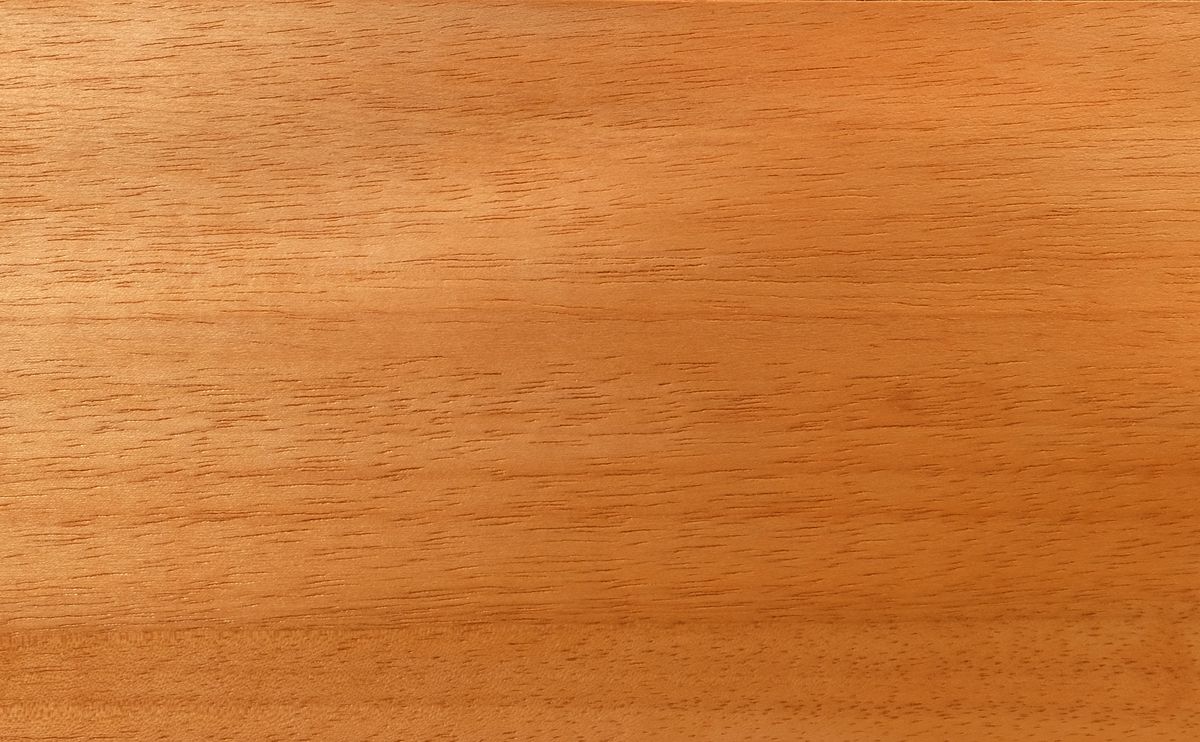
The heartwood runs from creamy white to reddish brown, and CIRAD describes pale pink brown with veining and a lustrous look. The sapwood is 1.2 to 2.4 in (3 to 6 cm) wide and hard to tell apart. Wavy grain can give a moire effect.
Grain/Texture
PROTA lists straight grain, sometimes interlocked, and a fine to moderately coarse texture. CIRAD lists a fine texture with slightly interlocked grain.
Rot Resistance
The wood is not durable. PROTA says fungi, termites, dry-wood borers and marine borers attack it. CIRAD rates it class 4 to 5 (poorly to not durable). The wood takes preservatives fairly easily.
Workability
Silica makes the blunting effect high, so use stellite-tipped saw teeth and tungsten carbide tools. Crosscutting, boring and mortising can splinter the wood. Nailing, screwing and slicing go well, and it stains, paints and glues well. Dry it with care, since blue stain is a risk.
Odor
Not confirmed. The Wood Database reports a faint cedar-like odor.
Allergies/Toxicity
Sources give no health data for this species. Health agencies treat all wood dust as a hazard, and it can irritate the nose, throat and skin. Wear a dust mask and use dust collection when you cut or sand it.
Pricing/Availability
PROTA says anigre ships as sawn wood and veneer, mixed with a close relative, Pouteria aningeri. Ghana exported about 459,000 ft³ (13,000 m³), roughly 5.5 million board feet, of veneer in 2004. The Wood Database says solid boards are sometimes seen. Price tier is Not confirmed.
Sustainability
The IUCN listing from 1998 puts Pouteria altissima at Lower Risk/conservation dependent, with a note that it needs updating, and says parts of its range are overexploited. CIRAD says it is not in the CITES Appendices (2025 list).
Common Uses
PROTA recommends anigre for sliced and peeled veneer. It also serves for light carpentry, joinery, high-class furniture and molding. In East Africa it also goes into light construction, vehicle bodies, musical instruments, crates, toys and railway sleepers.
Sources
- PROTA, Pouteria altissima (Lemmens 2007; Pl@ntUse), plantuse.plantnet.org
- CIRAD Tropix, Aningeria technical sheet (English; covers Pouteria altissima, P. pierrei and P. superba), tropix.cirad.fr
- IUCN Red List, Pouteria altissima (African Regional Workshop 1998), iucnredlist.org
- The Wood Database, anigre page (secondary reference, used for cross-checks and gaps), wood-database.com (lists the wood as Pouteria spp.)
- CITES Appendices I, II and III valid from March 5, 2026, cites.org
- CCOHS, Wood Dust – Health Effects (revised March 28, 2023), ccohs.ca
Photos
Veneer sheet