
Hardwood
Apple
Apple (Malus spp.) is a reddish gray to reddish brown, fine-textured hardwood from Europe and western Asia, used for furniture, turnings, mallet heads, tool handles and small specialty items. This guide covers its Janka hardness, weight, shrinkage, rot resistance, workability and common uses.
Photo: Philipp Zinger
Specs
Wood Name
Apple
Common Name(s)
Apple, common apple, wild apple, crab apple
Scientific Name
Malus spp. (the data below are for wild apple, Malus sylvestris (L.) Mill., not orchard apple, Malus domestica)
Wood Type
Hardwood
Distribution
Apple is native to Europe and western Asia. It grows wild in southern Great Britain and Scandinavia, and across Europe and southwestern Asia. People plant it in most temperate climates. It has escaped and naturalized locally across southern Canada, the eastern United States and the West Coast from Washington to California.
Tree Size
HNA says the tree rarely tops 30 ft (9 m). The bole is small and crooked, up to 12 in (0.3 m) across.
Average Dried Weight
HNA lists 47 lbs/ft³ (753 kg/m³) at 12% MC. Green wood weighs 55 lbs/ft³ (881 kg/m³). The Wood Database lists a higher 52 lbs/ft³ (830 kg/m³).Source: The Wood Database; Hardwoods of North America (HNA)
Specific Gravity (Basic, 12% MC)
HNA lists 0.61 basic (oven-dry weight, green volume) and 0.67 at 12% MC (oven-dry weight, volume at 12%). The oven-dry value is 0.74.Source: Hardwoods of North America (HNA)
Janka Hardness
The side hardness is 1,730 lbf (7,695 N) at 12% MC. Green wood measures 1,090 lbf (4,848 N).
Modulus of Rupture
The bending strength is 12,800 psi (88.3 MPa) at 12% MC. Green wood measures 7,400 psi (51.0 MPa).
Elastic Modulus
The stiffness is 1,270,000 psi (8,757 MPa) at 12% MC. Green wood measures 1,050,000 psi (7,239 MPa).
Crushing Strength
The crushing strength parallel to grain is 6,030 psi (41.6 MPa) at 12% MC. Green wood measures 3,000 psi (20.7 MPa).
Shrinkage
Green to oven-dry, the wood shrinks 5.6% radially, 10.1% tangentially and 17.6% by volume. The tangential to radial ratio is 1.8. That high movement means big seasonal change in service.
Description
Color/Appearance
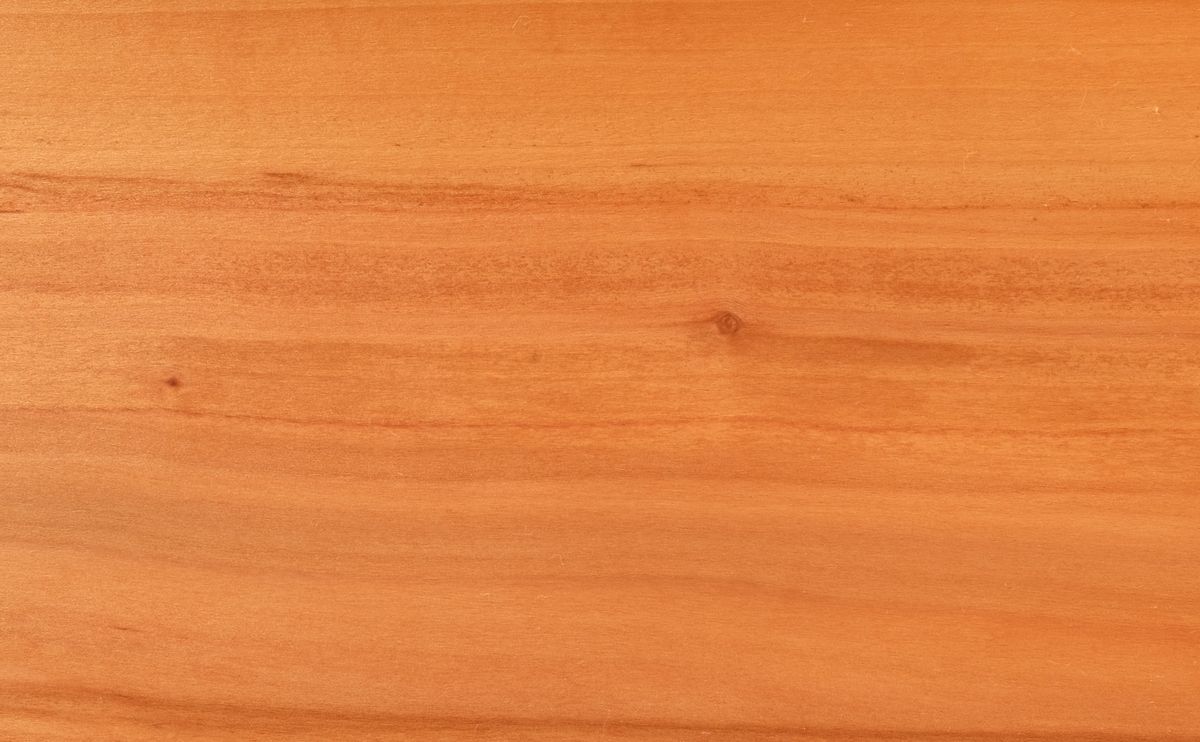
The heartwood is reddish gray, and the sapwood is light reddish, with 12 to 30 rings of sapwood. Steaming turns the wood reddish brown to dark red brown. Wild trees give better wood than cultivated ones, HNA says.
Grain/Texture
HNA gives no texture. The Wood Database describes straight grain, wild in some parts of the tree, and a very fine, even texture that closely resembles cherry.
Rot Resistance
HNA rates apple heartwood as nonresistant to decay when exposed.
Workability
HNA says apple is hard and difficult to work, and very hard to split. It converts cleanly and saws with moderate effort. Planing is easier when the cutting angle is set to 20 degrees. It stains and polishes easily. The Wood Database adds that it turns well and can burn when machined.
Odor
Not confirmed. The Wood Database reports a faint, sweet scent when the wood is worked.
Allergies/Toxicity
HNA has no toxicity information, and The Wood Database reports no species-specific reactions. Health agencies treat all wood dust as a hazard, and it can irritate the nose, throat and skin. Wear a dust mask and use dust collection when you cut or sand it.
Pricing/Availability
Apple rarely appears as lumber, and the pieces are small, suited to small projects. Price tier is Not confirmed.
Sustainability
IUCN rates one apple species, Malus sylvestris, as Data Deficient (2022 assessment). There is no Red List rating for the genus as a whole. Malus does not appear in the CITES Appendices valid from March 5, 2026.
Common Uses
HNA lists furniture, turnings, mallet heads, skittle balls, umbrella handles, toys, cog wheels, fruit presses, wood screws, plane blocks, canes, drawing instruments, pianos and tool handles.
Sources
- Hardwoods of North America, USDA Forest Products Laboratory, FPL-GTR-83 (Malus sylvestris entry), doi.org
- IUCN Red List, Malus sylvestris (crab apple; assessed 2022), iucnredlist.org
- The Wood Database, apple page (secondary reference, used for cross-checks and gaps), wood-database.com (lists Malus spp.)
- CITES Appendices I, II and III valid from March 5, 2026, cites.org
- CCOHS, Wood Dust – Health Effects (revised March 28, 2023), ccohs.ca
Photos
Veneer sheet