
Hardwood
Apricot
Apricot (Prunus armeniaca) is a fine-textured, light brown hardwood from a small fruit tree, sold as small turning blanks and used for turned objects, instruments and carvings. This guide covers its Janka hardness, weight, shrinkage, rot resistance, workability and common uses.
Specs
Wood Name
Apricot
Common Name(s)
Apricot
Scientific Name
Prunus armeniaca L.
Wood Type
Hardwood
Distribution
The Wood Database says apricot is native to eastern Europe and Asia, and that growers have planted it worldwide.
Tree Size
The Wood Database lists 20 to 40 ft (6 to 12 m) tall with a trunk 12 to 18 in (0.3 to 0.4 m) across. We found no second source.
Average Dried Weight
The Wood Database lists 46 lbs/ft³ (745 kg/m³) at 12% MC. We found no second source.Source: The Wood Database
Specific Gravity (Basic, 12% MC)
The Wood Database lists 0.58 basic (oven-dry weight, green volume) and 0.74 at 12% MC. We found no second source.Source: The Wood Database
Janka Hardness
The Wood Database lists 1,390 lbf (6,200 N) and marks it as an estimate from density, not a measured test. We found no second source.Source: The Wood Database
Modulus of Rupture
Not confirmed
Elastic Modulus
Not confirmed
Crushing Strength
Not confirmed
Shrinkage
Not confirmed
Description
Color/Appearance
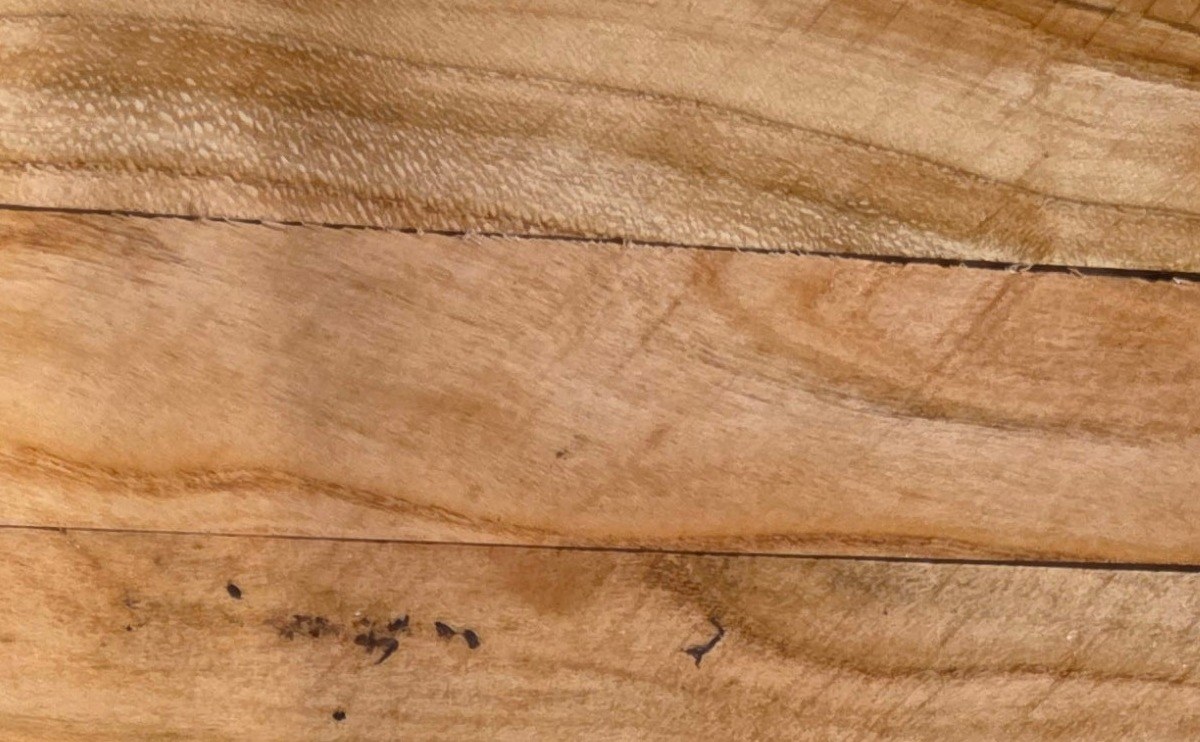
The heartwood is light brown, at times with a reddish or orange tint, and darker brown streaks are common. The sapwood is thin and slightly paler.
Grain/Texture
The texture is fine and even, with moderate luster. The wood is semi-ring-porous, with small to medium pores that are very numerous.
Rot Resistance
Not confirmed
Workability
The Wood Database says clear, straight-grained pieces are easy to work. Irregular grain and knots call for slower, careful cuts. Apricot bonds, turns and takes a finish well.
Odor
The Wood Database reports no characteristic odor.
Allergies/Toxicity
The Wood Database reports no health reactions beyond the usual wood dust risks. Health agencies treat all wood dust as a hazard, and it can irritate the nose, throat and skin. Wear a dust mask and use dust collection when you cut or sand it.
Pricing/Availability
Small trees mean apricot does not come as lumber. Hobbyists and small specialty dealers sell it mainly as turning blanks and other small stock. The Wood Database expects prices on the high side for a domestic wood. Prices are not quoted here.
Sustainability
IUCN rates Prunus armeniaca as Data Deficient (assessed 2020), which means there is not enough data to judge its risk. It does not appear in the CITES Appendices valid from March 5, 2026.
Common Uses
The Wood Database lists carvings, knife handles, turned objects and musical instruments.
Sources
- IUCN Red List, Prunus armeniaca (2020), iucnredlist.org
- The Wood Database, apricot page (secondary reference, used for cross-checks and gaps), wood-database.com
- CITES Appendices I, II and III valid from March 5, 2026, cites.org
- BfN CITES tree list, March 5, 2026 (pointer only; the Appendices above are the legal text), bfn.de
- CCOHS, Wood Dust – Health Effects (revised March 28, 2023), ccohs.ca
- Oakbrook Woodturning Supply, apricot pen blank (banner photo credit), oakbrookwoodturningsupply.com
Photos
Face grain, blanks