
Softwood
Alaskan Yellow Cedar
Alaskan yellow cedar (Cupressus nootkatensis), also placed in Callitropsis and Xanthocyparis, is a bright yellow, durable softwood of the Pacific Northwest, used for boats, decking, siding and carving. This guide covers its Janka hardness, weight, shrinkage, rot resistance, workability and common uses.
Specs
Wood Name
Alaskan Yellow Cedar
Common Name(s)
Alaskan yellow cedar, Alaska-cedar, Alaska yellow-cedar, yellow-cedar, Alaska cypress, Nootka cypress
Scientific Name
Cupressus nootkatensis D.Don. The name has been moved often. It is also treated as Callitropsis nootkatensis (formerly Xanthocyparis nootkatensis) and as Chamaecyparis nootkatensis. All four names refer to the same tree. The tree is not a true cedar (genus Cedrus) and belongs to the cypress family, Cupressaceae.
Wood Type
Softwood
Distribution
The tree grows along the Pacific coast of northwestern North America, from northern California to Prince William Sound, Alaska, usually within 100 miles (160 km) of the coast, including the Cascade Range and Olympic Mountains. It is extant in British Columbia, Alaska, California, Oregon and Washington.
Tree Size
Some accounts list 100 to 120 ft (30 to 37 m) tall with a trunk 48 to 72 in (1.2 to 1.8 m) across. Dominant trees on better sites in Washington are typically 100 to 125 ft (30 to 38 m) tall; in British Columbia they are often 75 to 100 ft (23 to 30 m) tall and 36 in (90 cm) in diameter; in Alaska they are often 80 ft (24 m) tall and 24 in (60 cm) in diameter, though larger trees are common. The record tree in Olympic National Park is 120 ft (37 m) tall and 144 in (3.7 m) in diameter.
Average Dried Weight
Average dried weight is 31 lbs/ft³ (495 kg/m³) at 12% MC.
Specific Gravity (Basic, 12% MC)
Specific gravity is 0.42 basic (oven-dry weight, green volume). At 12% MC, published values are 0.44 and 0.50.
Janka Hardness
Side hardness is 580 lbf (2,580 N) at 12% MC.
Modulus of Rupture
Modulus of rupture is 11,100 psi (76.5 MPa) at 12% MC.
Elastic Modulus
Elastic modulus is 1,420,000 psi (9,790 MPa) at 12% MC.
Crushing Strength
Crushing strength is 6,310 psi (43.5 MPa) parallel to grain at 12% MC.
Shrinkage
Green to oven-dry, shrinkage is 2.8% radial, 6.0% tangential and 9.2% by volume. The tangential to radial ratio works out to 2.1. The wood shrinks little in drying and is stable afterward.
Description
Color/Appearance
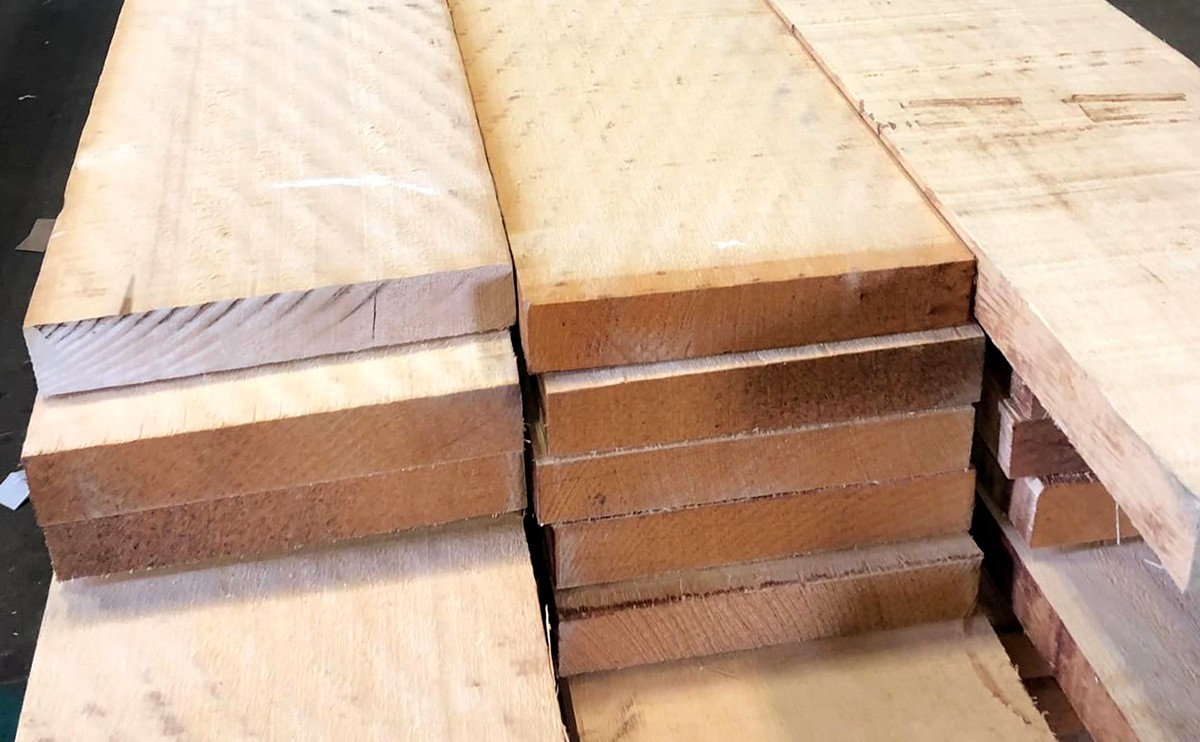
The heartwood is bright, clear yellow, with narrow white to yellowish sapwood that is hard to tell from the heartwood. The color also darkens in light, and weathers to a uniform gray outdoors.
Grain/Texture
The wood is fine textured and generally straight grained. The grain is usually straight, sometimes wavy, with a uniform medium to fine texture.
Rot Resistance
The heartwood is described as very resistant to decay, and also as durable to very durable and resistant to most insects.
Workability
It is easy to work with hand and machine tools, though wavy grain may tear in planing. It holds paint well and stains, glues and finishes well. The wood mills well, does not split or check readily, and wears smoothly.
Odor
The odor is mild and distinctive. It is also described as like raw potatoes.
Allergies/Toxicity
Serious reactions are rare, though skin irritation has been reported with Alaskan yellow cedar. Health agencies treat all wood dust as a hazard, and it can irritate the nose, throat and skin. Wear a dust mask and use dust collection when you cut or sand it.
Pricing/Availability
Supply is limited. High prices are expected for a domestic softwood, especially for clear, knot-free stock. Most high-quality logs are exported to Japan. Prices are not quoted here.
Sustainability
Callitropsis nootkatensis (this species) is listed as Least Concern (assessed July 9, 2012; published 2013, marked as needing an update). The assessment gives no criteria code. The population trend is listed as stable.
Common Uses
Uses include interior woodwork, furniture, small boats, cabinetwork and novelties, and also boatbuilding, utility poles, heavy flooring, framing, bridge and dock decking, marine piling, tanks, patterns, molding, sash, doors, paneling, toys, musical instruments, carving, siding, flooring, decking, outdoor furniture and flutes or guitar soundboards.
Sources
- IUCN Red List, Callitropsis nootkatensis (assessed 2012, published 2013; formerly Xanthocyparis nootkatensis), iucnredlist.org
- USDA Forest Service, Silvics of North America, Volume 1, Conifers (Agriculture Handbook 654), Chamaecyparis nootkatensis (Harris, 1990), research.fs.usda.gov
- USDA Forest Service, Wood Handbook (FPL-GTR-282), chapter 5, Tables 5-3a and 5-3b (strength of U.S. softwoods), research.fs.usda.gov
- USDA Forest Service, Wood Handbook (FPL-GTR-282), chapter 4, Table 4-3a (shrinkage), research.fs.usda.gov
- USDA Forest Service, Wood Handbook (FPL-GTR-282), chapter 14, Table 14-1 (decay resistance groups), research.fs.usda.gov
- USDA Forest Service, Wood Handbook (FPL-GTR-282), chapter 2 (species notes), research.fs.usda.gov
- The Wood Database, alaskan-yellow-cedar page (secondary reference, used for cross-checks and gaps), wood-database.com
- CITES Appendices I, II and III valid from March 5, 2026, cites.org
- CITES Checklist search, Cupressus nootkatensis and Callitropsis nootkatensis (no listing returned; the Appendices above are the legal text), checklist.cites.org
- BfN CITES tree list, March 5, 2026 (pointer only; the Appendices above are the legal text), bfn.de
- CCOHS, Wood Dust – Health Effects (revised March 28, 2023), ccohs.ca
- Photo: Alan McIlvain Lumber Company, alanmcilvain.com
- Photo: Rare Woods USA, rarewoodsusa.com
Photos
Board ends, stacked boards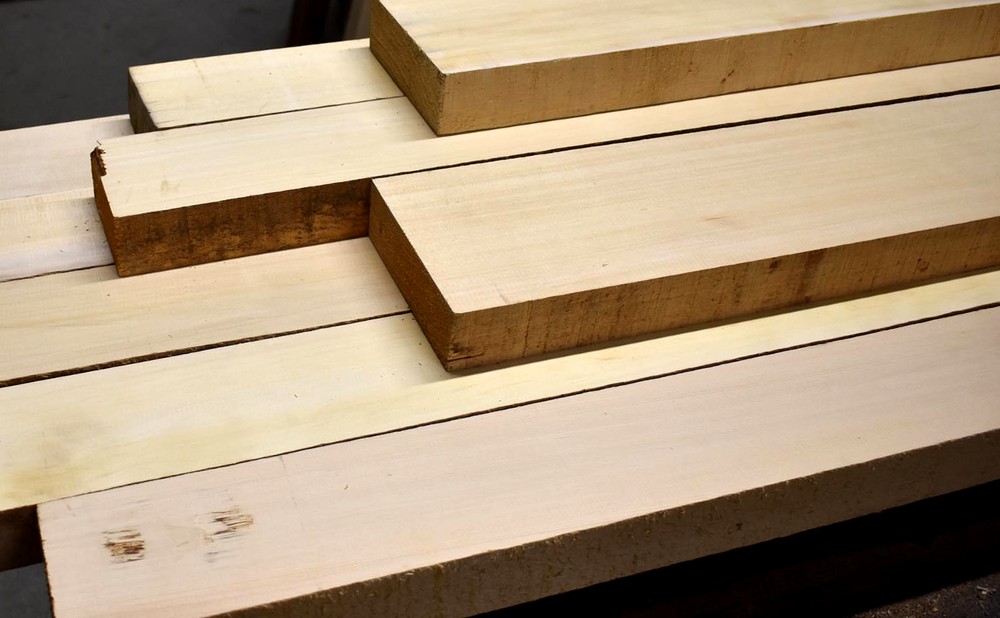 Boards, stacked
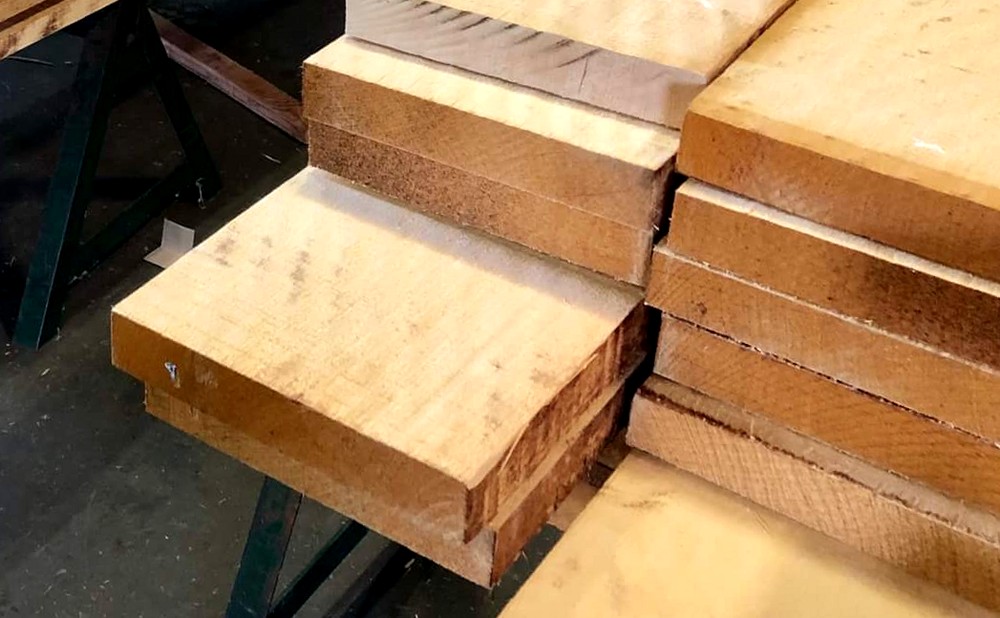 Board ends, two piles