
Hardwood
Afzelia Xylay
Afzelia xylay (Afzelia xylocarpa) is a reddish brown, moderately coarse hardwood from mainland Southeast Asia, used for fine furniture, flooring, doors and decorative veneer. This guide covers its Janka hardness, weight, shrinkage, rot resistance, workability and common uses.
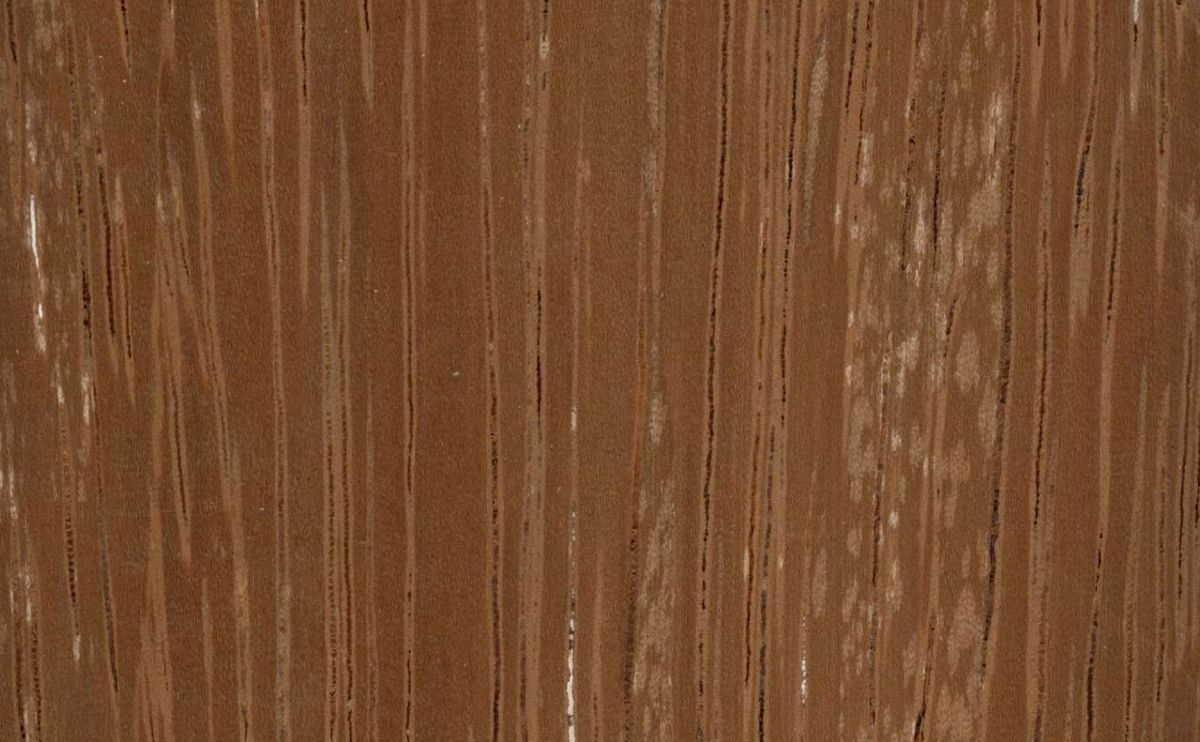
Photo: CIRAD
Specs
Wood Name
Afzelia Xylay
Common Name(s)
Afzelia xylay, makha-mong (Thailand), beng (Cambodia), kha (Laos). Traders also sell figured pieces as xylay lace.
Scientific Name
Afzelia xylocarpa (Kurz) Craib
Wood Type
Hardwood
Distribution
Afzelia xylocarpa is the one Afzelia species native to mainland Southeast Asia. IUCN lists it in Cambodia, Laos, Myanmar, Thailand and Vietnam. It grows scattered in mixed deciduous and dry evergreen forest, usually on well-drained clay or laterite soil, at elevations up to about 2,950 ft (900 m).
Tree Size
PROSEA describes Asian Afzelia trees as up to 138 ft (42 m) tall. The clear trunk is 49 to 66 ft (15 to 20 m) long and up to 4 ft (120 cm) across, and sometimes up to 6 ft (180 cm). These figures cover the whole Asian group, not this species alone. The trees grow slowly.
Average Dried Weight
PROSEA lists 53.1 to 56.2 lbs/ft³ (850 to 900 kg/m³) at 15% MC.Source: PROSEA, at 15% MC
Specific Gravity (Basic, 12% MC)
Not confirmed. The air-dry density at 15% MC is 0.85 to 0.90 g/cm³ (PROSEA). No basic specific gravity was found for this species.Source: PROSEA
Janka Hardness
Not confirmed for Afzelia xylocarpa. For the related Philippine species Afzelia rhomboidea, PROSEA lists a side hardness of 1,720 lbf (7,635 N) on green wood.Source: PROSEA, for Afzelia rhomboidea (green wood)
Modulus of Rupture
The bending strength is 13,780 to 18,130 psi (95 to 125 MPa) at 15% MC (PROSEA).Source: PROSEA, at 15% MC
Elastic Modulus
Not confirmed for Afzelia xylocarpa. PROSEA lists 1,595,000 psi (11,000 MPa) for green Afzelia rhomboidea.Source: PROSEA, for green Afzelia rhomboidea
Crushing Strength
The crushing strength parallel to grain is 7,690 to 9,430 psi (53 to 65 MPa) at 15% MC (PROSEA).Source: PROSEA, at 15% MC
Shrinkage
Not confirmed as numbers. PROSEA says the wood seasons well, with little shrinkage and warping.Source: PROSEA
Description
Color/Appearance
The heartwood is reddish yellow to red or dirty red brown, often with streaks. It stands out clearly from the grey white sapwood. Planed surfaces are often glossy.
Grain/Texture
The grain is interlocked, or sometimes straight. The texture runs from moderately fine to moderately coarse.
Rot Resistance
The wood is very durable. PROSEA puts its life in tropical exposure at about 10 years.
Workability
The wood is heavy and hard. PROSEA calls it moderately difficult to work, but easier than other very dense woods. It takes a high finish. Tool wear, gluing and nailing are Not confirmed.
Odor
Not confirmed
Allergies/Toxicity
Not confirmed for this species. PROTA reports that African Afzelia dust can cause allergic reactions and asthma in woodworkers. Health agencies treat all wood dust as a hazard, and it can irritate the nose, throat and skin. Wear a dust mask and use dust collection when you cut or sand it.
Pricing/Availability
Thailand is the main user. It cut 25,000 to 40,000 m³ a year of this timber in the late 1980s, mostly for its own furniture and parquet. PROSEA says the timber is not important in trade elsewhere in Southeast Asia. Availability and price in North America are Not confirmed.
Sustainability
IUCN rates Afzelia xylocarpa as Endangered (criteria A1cd, assessed 1998, marked as needing an update). The CITES listing for Afzelia covers African populations only, so this Asian species is not covered by it. Check your own country’s import rules before you buy.
Common Uses
Afzelia wood is used for high grade furniture, cabinet work, parquet flooring and interior finish. Builders use it for door and window frames, beams, paneling and stairs. It is also used for handicrafts, musical instruments, farm tools, boats, carts and railway sleepers. Makers cut decorative veneer from it.
Sources
- PROSEA, Afzelia J.E. Smith (Phengklai, Smitinand, van der Zwan, den Outer and Sosef 1993; genus entry that includes Afzelia xylocarpa), prosea.prota4u.org
- IUCN Red List, Afzelia xylocarpa (Nghia 1998), iucnredlist.org
- PROTA, Afzelia africana (Gerard and Louppe 2011, used for the dust note only), plantuse.plantnet.org
- CITES Appendices I, II and III valid from March 5, 2026 (Afzelia spp., African populations only, annotation #17), cites.org
- CCOHS, Wood Dust – Health Effects (revised March 28, 2023), ccohs.ca
Photos
Wood sample