
Hardwood
Afzelia
Afzelia (Afzelia spp.) is a golden to reddish brown African hardwood with a medium to coarse texture, prized for exterior joinery, doors, flooring and furniture. This guide covers its Janka hardness, weight, shrinkage, rot resistance, workability and common uses.
Photo: Philipp Zinger
Specs
Wood Name
Afzelia
Common Name(s)
Afzelia, doussié (Cameroon), lingué, apa and aligna (Nigeria), papao (Ghana), mkora (Tanzania), chanfuta and mussacossa (Mozambique), African oak
Scientific Name
Afzelia spp. The African species sold as doussié include Afzelia africana, Afzelia bella, Afzelia bipindensis, Afzelia pachyloba and Afzelia quanzensis.
Wood Type
Hardwood
Distribution
Afzelia grows in West, Central and East Africa. Afzelia africana is the most widespread. It occurs from Senegal east to Uganda and south to DR Congo. Afzelia bipindensis ranges from southern Nigeria to western Uganda and south to northern Angola. Afzelia pachyloba ranges from southern Nigeria to the Central African Republic and Cabinda (Angola). The trees grow in dense evergreen forest, and in savanna and coastal forest in East Africa.
Tree Size
In good forest the trees reach 80 to 120 ft (24 to 37 m) tall. The clear trunk is 30 to 50 ft (9 to 15 m) long. The trunk is usually 3 to 5 ft (90 to 150 cm) across and sometimes wider. Large, irregular buttresses can be present at the base.
Average Dried Weight
The air-dry weight is 51 lbs/ft³ (817 kg/m³) in the USDA data. Other sources list 44.9 to 53.1 lbs/ft³ (720 to 850 kg/m³) at 12% MC.Source: USDA Tropical Timbers of the World (AH-607); CIRAD, ITTO and PROTA for the range
Specific Gravity (Basic, 12% MC)
The basic specific gravity (oven-dry weight, green volume) is 0.67 in the USDA data. ITTO lists 0.70 for Afzelia africana. The value at 12% MC on an oven-dry weight basis is not confirmed. The air-dry density at 12% MC is 0.79 to 0.80 g/cm³ (ITTO and CIRAD).Source: USDA Tropical Timbers of the World (AH-607); ITTO and CIRAD
Janka Hardness
The side hardness is 1,770 to 1,850 lbf (7,870 to 8,230 N) on dry wood.Source: USDA Tropical Timbers of the World (AH-607), dry side hardness
Modulus of Rupture
The bending strength is 18,100 psi (124.8 MPa) at 12% MC in the USDA data. CIRAD lists 17,980 psi (124 MPa).Source: USDA Tropical Timbers of the World (AH-607), at 12% MC; CIRAD
Elastic Modulus
The stiffness is 1,900,000 psi (13,100 MPa) at 12% MC in the USDA data. Other sources range from 2,031,000 to 2,469,000 psi (14,000 to 17,020 MPa).Source: USDA Tropical Timbers of the World (AH-607), at 12% MC; PROTA for the range
Crushing Strength
The crushing strength parallel to grain is 11,490 psi (79.2 MPa) at 12% MC in the USDA data. CIRAD lists 10,730 psi (74 MPa).Source: USDA Tropical Timbers of the World (AH-607), at 12% MC; CIRAD
Shrinkage
Green to oven-dry, the wood shrinks 3.0% radially and 4.4% tangentially, so the tangential to radial ratio is 1.5 (CIRAD). USDA lists a smaller change from green to 12% MC: 1.0% radial and 1.5% tangential. The wood is very stable in use.Source: CIRAD Tropix, green to oven-dry; USDA Tropical Timbers of the World (AH-607) for green to 12% MC
Description
Color/Appearance
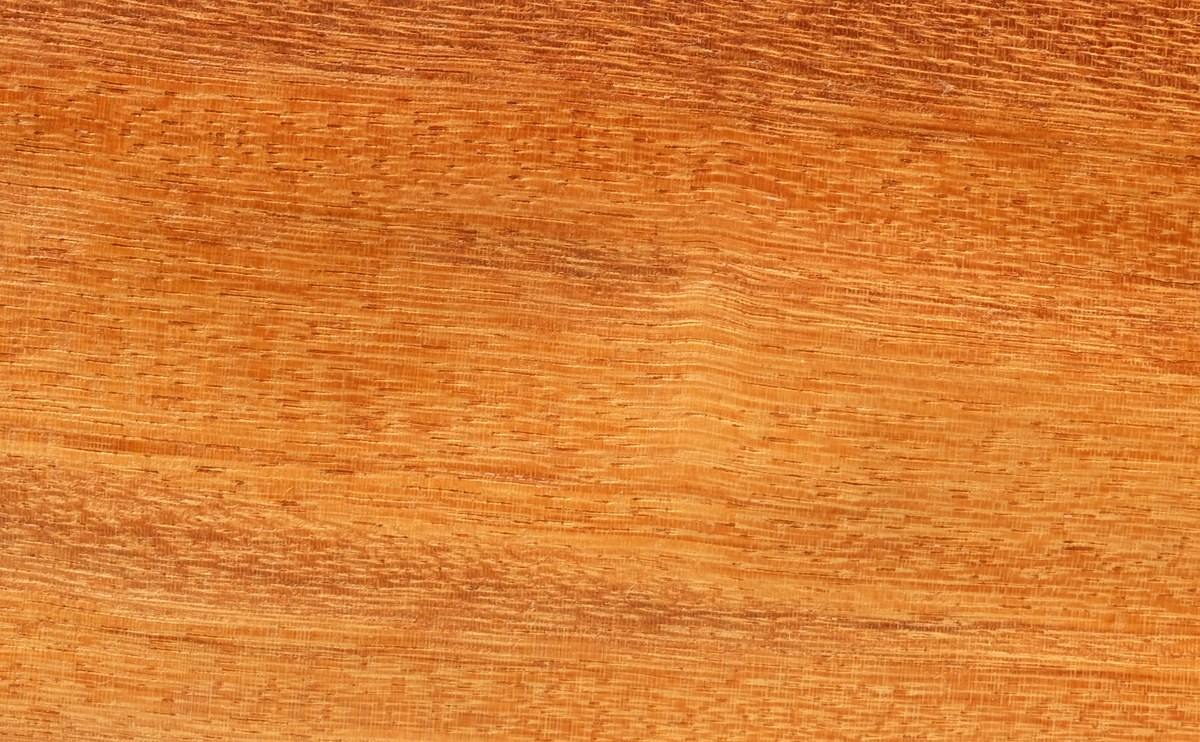
The heartwood is golden brown to pale red brown and turns red brown with age. It sometimes has darker streaks. The sapwood is whitish to pale yellow and clearly set apart. Yellow powder in the pores can stain cloth or paper in damp conditions.
Grain/Texture
The grain is straight to interlocked. The texture is medium to coarse but even, and the luster is slight to medium.
Rot Resistance
The heartwood is very durable. CIRAD rates it class 1 on the European EN 350 scale, where class 1 is the best. It resists termites, dry-wood borers and acids well. Marine borers can attack it. The sapwood is open to powderpost beetles. The heartwood is extremely hard to treat with preservatives.
Workability
Afzelia is hard on tools. It needs powerful equipment to saw, and it dulls cutters. Use carbide cutters and lower the cutting angle when the grain is interlocked. It planes to a smooth finish, though the grain can tear on quartersawn faces. Drill pilot holes before you nail or screw it. Glue can be hard to bond because of the wood’s extractives. The wood is hard to stain where the pores hold yellow deposits. It dries slowly, and boards can take three to five months. It bends moderately with steam.
Odor
The smell is weak. USDA reports no characteristic odor, while PROTA says dry wood smells like leather when planed.
Allergies/Toxicity
Afzelia dust can irritate the nose and throat. PROTA says it can cause allergic reactions and asthma in woodworkers. Health agencies treat all wood dust as a hazard. The International Agency for Research on Cancer (IARC) classes wood dust as carcinogenic to humans, with links to cancers of the nose and sinuses. Wear a dust mask and use dust collection when you cut or sand it.
Pricing/Availability
Afzelia is a heavy African hardwood sold as lumber, veneer and flooring, mostly under the trade name doussié. PROTA names Cameroon as the main exporting country. International trade is controlled under CITES, so shipments need permits. We have not confirmed its supply or price tier in North America.
Sustainability
Afzelia species from Africa are listed in CITES Appendix II. The listing covers logs, sawn wood, veneer sheets, plywood and transformed wood (annotation #17 in the Appendices valid from March 5, 2026). Only African populations are included. The IUCN Red List rates Afzelia africana as Vulnerable (criteria A2cd, assessed 2019). It rates Afzelia bipindensis and Afzelia pachyloba as Vulnerable in assessments from 1998. It rates Afzelia bella and Afzelia quanzensis as Least Concern (2019). Check your own country’s import rules before you buy.
Common Uses
Afzelia is used for exterior joinery, doors, window frames, flooring, stairs and furniture. Builders also use it for bridges, heavy construction, boat keels and decks, and decorative veneer. Its acid resistance suits vats and tanks. Makers also carve it and use it for drums.
Sources
- Chudnoff, M. 1984. Tropical Timbers of the World, USDA Agriculture Handbook 607 (Afzelia spp.), research.fs.usda.gov
- CIRAD Tropix, Doussié technical sheet (2026 edition), tropix.cirad.fr
- ITTO Tropical Timber lesser used species database, Doussié (Afzelia africana), tropicaltimber.info
- PROTA, Afzelia africana (Gérard and Louppe 2011), plantuse.plantnet.org
- PROTA, Afzelia bipindensis, plantuse.plantnet.org
- PROTA, Afzelia pachyloba, plantuse.plantnet.org
- IUCN Red List, Afzelia africana, iucnredlist.org
- IUCN Red List, Afzelia bipindensis, iucnredlist.org
- IUCN Red List, Afzelia pachyloba, iucnredlist.org
- IUCN Red List, Afzelia quanzensis, iucnredlist.org
- IUCN Red List, Afzelia bella, iucnredlist.org
- CITES Appendices I, II and III (valid from March 5, 2026), cites.org
- CCOHS, Wood Dust: Health Effects (revised 2023-03-28), ccohs.ca
Photos
Veneer face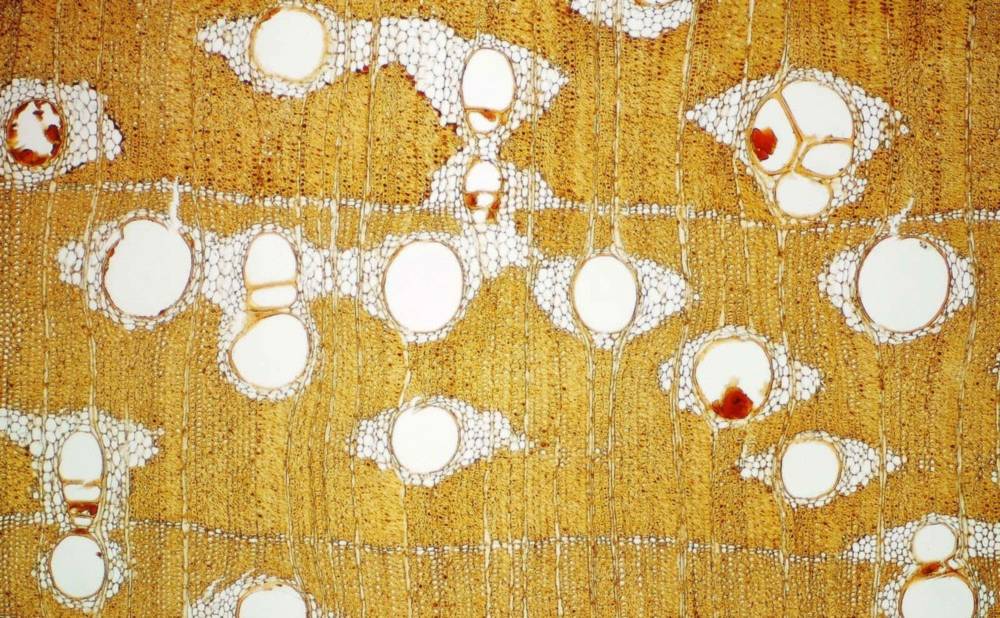 End grain, microscope