
Hardwood
Amoora
Amoora (Aglaia spectabilis) is a pale red to dark reddish brown, interlocked-grain hardwood from Southeast Asia and the Pacific, used for house building, planking, furniture and veneer. This guide covers its Janka hardness, weight, shrinkage, rot resistance, workability and common uses.
Photo: CIRAD
Specs
Wood Name
Amoora
Common Name(s)
Amoora, aglaia, bekak (Malaysia), surian batu (Peninsular Malaysia), lantupak (Sabah), langsat-langsat (Malay)
Scientific Name
Aglaia spectabilis (Miq.) S.S.Jain & S.Bennet (synonyms Amoora gigantea, Aglaia gigantea)
Wood Type
Hardwood
Distribution
Amoora grows from northeastern India through Indochina to Malaysia, Sumatra, Borneo, Sulawesi, New Guinea, the Solomon Islands and Cape York in Queensland. IUCN adds southern China and the Philippines. It lives in primary and secondary rainforest, riverside forest and coastal forest. PROSEA gives a ceiling of 2,300 ft (700 m), while IUCN reports records up to 6,230 ft (1,900 m).
Tree Size
The tree reaches 131 ft (40 m). The clear bole runs up to 59 ft (18 m) and measures up to 59 in (150 cm) across. Buttresses stand up to 13 ft (4 m) high.
Average Dried Weight
PROSEA lists 38.1 to 49.3 lbs/ft³ (610 to 790 kg/m³) at 12% MC for this species. The Wood Database lists 40.9 lbs/ft³ (655 kg/m³).Source: PROSEA; The Wood Database
Specific Gravity (Basic, 12% MC)
Not confirmed as a specific gravity in PROSEA, which gives density only. The Wood Database lists 0.57 basic (oven-dry weight, green volume) and 0.66 at 12% MC.Source: PROSEA; The Wood Database
Janka Hardness
Not confirmed for this species. PROSEA gives a measured side hardness of 850 lbf (3,785 N) for the whole Aglaia genus at 12% MC. The Wood Database lists an estimated 1,280 lbf (5,700 N), derived from density rather than tested.Source: PROSEA; The Wood Database
Modulus of Rupture
The Wood Database lists 13,000 psi (89.6 MPa). PROSEA gives 11,750 to 21,030 psi (81 to 145 MPa) at 12% MC, but that range covers the whole Aglaia genus.Source: PROSEA; The Wood Database
Elastic Modulus
Not confirmed for this species. PROSEA gives 1,691,000 to 2,289,000 psi (11,660 to 15,780 MPa) at 12% MC for the whole Aglaia genus.Source: PROSEA
Crushing Strength
The Wood Database lists 7,900 psi (54.5 MPa) parallel to grain. PROSEA gives 6,670 to 7,980 psi (46 to 55 MPa) at 12% MC for the whole genus.Source: PROSEA; The Wood Database
Shrinkage
Green to oven-dry, The Wood Database lists 5.0% radial, 7.8% tangential and 13.0% by volume, a ratio of 1.6. PROSEA gives 4.1 to 6.8% radial and 6.9 to 10.7% tangential for the genus. Form stability is good once the wood is dry.Source: PROSEA; The Wood Database
Description
Color/Appearance
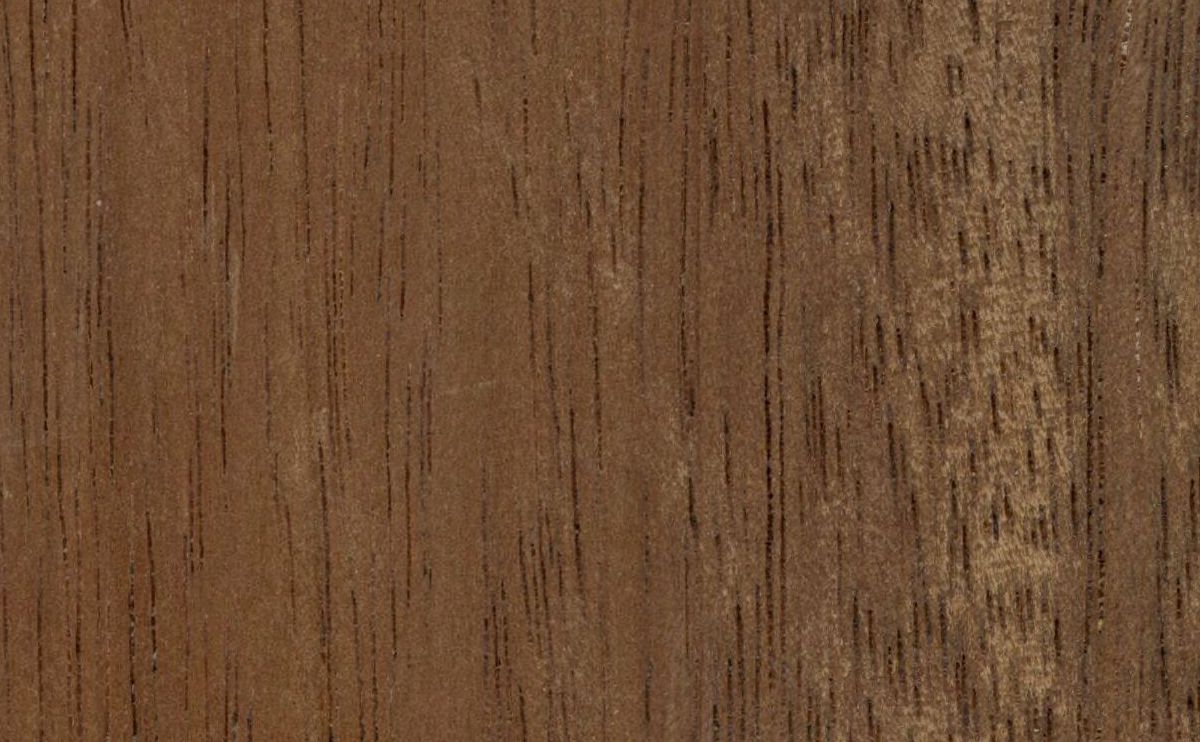
The heartwood runs from pale red to dark reddish brown, and it can turn walnut or chestnut brown. The sapwood is pale yellow to pale red brown. Radial faces show a diagonal, wavy ribbon figure. Heavier pieces tend to be darker.
Grain/Texture
The grain is interlocked, sometimes straight. PROSEA calls the texture moderately fine to moderately coarse for the genus. The Wood Database calls it fine and even. The wood has a moderate luster.
Rot Resistance
PROSEA rates Aglaia wood moderately durable to durable, even in ground contact, though some species are non-durable. Malaysia rates its amoora group moderately durable. The heartwood resists preservatives and the sapwood takes them.
Workability
PROSEA says workability is good for the genus. The wood saws and machines well, though heavier pieces need power. Curly grain calls for sharp, fine-set planes, and finishing gives smooth, lustrous surfaces. Drying brings little damage, but slight collapse and twist can occur, so weight the stacks.
Odor
PROSEA says fresh wood often smells fragrant, resembling both cedar and camphor.
Allergies/Toxicity
PROSEA says the sawdust of several Aglaia species may cause dermatitis. Health agencies treat all wood dust as a hazard, and it can irritate the nose, throat and skin. Wear a dust mask and use dust collection when you cut or sand it.
Pricing/Availability
The Wood Database says amoora is not commonly exported, so supply is mostly local within its range. PROSEA calls the wood of excellent quality. Price tier and North American supply are Not confirmed.
Sustainability
IUCN rates Aglaia spectabilis as Least Concern (assessed July 13, 2017). Local logging and farm expansion are minor threats across its wide range. The species does not appear in the CITES Appendices valid from March 5, 2026.
Common Uses
PROSEA lists house building, planking and rifle butts. IUCN adds plywood, veneer, furniture, sports equipment and tools. The Wood Database adds cabinetry, boat building, gunstocks and turned objects.
Sources
- PROSEA, Aglaia spectabilis (Pl@ntUse), plantuse.plantnet.org
- PROSEA Timbers, Aglaia genus (Pl@ntUse; genus-level strength, shrinkage and working notes), plantuse.plantnet.org
- IUCN Red List, Aglaia spectabilis (Barstow 2018), iucnredlist.org
- Malaysian Timber Council, Amoora (Aglaia sect. Amoora) timber report, mtc.com.my
- The Wood Database, amoora page (secondary reference, used for cross-checks and gaps), wood-database.com
- CITES Appendices I, II and III valid from March 5, 2026, cites.org
- CCOHS, Wood Dust – Health Effects (revised March 28, 2023), ccohs.ca
Photos
Wood sample