

Hardwood
Bigtooth Aspen
Bigtooth aspen (Populus grandidentata) is a light, pale hardwood of northeastern North America, used mainly for pulp, pallets, boxes, veneer and other utility wood. This guide covers its Janka hardness, weight, shrinkage, rot resistance, workability and common uses.
Specs
Wood Name
Bigtooth Aspen
Common Name(s)
Bigtooth aspen, largetooth aspen, poplar, popple
Scientific Name
Populus grandidentata Michx.
Wood Type
Hardwood
Distribution
Bigtooth aspen is native to northeastern and north-central North America, from Cape Breton Island, Nova Scotia, west to southeastern Manitoba, south through Minnesota and Iowa to extreme northeastern Missouri, and east to southern Illinois, Kentucky, Virginia and Delaware, with local stands in western North Carolina and northwestern Tennessee.
Tree Size
Mature trees are usually 60 to 80 ft (18 to 24 m) tall and 8 to 10 in (20 to 25 cm) in diameter, and can reach 100 ft (30 m) on the best sites. Other accounts list 65 to 80 ft (20 to 25 m) tall with a much larger trunk, 18 to 24 in (0.6 to 0.7 m) across.
Average Dried Weight
Average dried weight is 27 lbs/ft³ (435 kg/m³) at 12% MC.
Specific Gravity (Basic, 12% MC)
Specific gravity is 0.36 basic (oven-dry weight, green volume). At 12% MC, published values are 0.39 and 0.43.
Janka Hardness
Side hardness is 420 lbf (1,870 N).
Modulus of Rupture
Modulus of rupture is 9,100 psi (62.8 MPa) at 12% MC.
Elastic Modulus
Elastic modulus is 1,430,000 psi (9,860 MPa) at 12% MC.
Crushing Strength
Crushing strength is 5,300 psi parallel to grain at 12% MC (published conversions are 36.5 MPa and 36.6 MPa).
Shrinkage
Green to oven-dry, shrinkage is 3.3% radial, 7.9% tangential and 11.8% by volume. The tangential to radial ratio works out to 2.4. Aspen shrinkage is also described as moderately high.
Description
Color/Appearance
Some boards show grayish white to light grayish brown heartwood, with lighter sapwood that usually blends into the heartwood. Others are described as light brown, with wide pale yellow to nearly white sapwood that is not sharply separated.
Grain/Texture
The grain is usually straight. Texture is described as fine and uniform, or as uniform and medium with low luster.
Rot Resistance
The aspens fall in the lowest decay-resistance group (slightly or nonresistant). The wood is also rated non-durable and open to insects.
Workability
The wood is easily worked and, when well dried, does not give odor or flavor to food. It works easily but needs sharp cutters to avoid a fuzzy surface, does not split easily, holds nails poorly, and can warp in drying. It glues and finishes well.
Odor
No characteristic odor is reported. Well-dried aspen lumber does not impart odor or flavor to food.
Allergies/Toxicity
No health reactions are reported beyond the usual wood dust risks. Health agencies treat all wood dust as a hazard, and it can irritate the nose, throat and skin. Wear a dust mask and use dust collection when you cut or sand it.
Pricing/Availability
Aspen is commonly cut for lumber and pulp. Wide boards should be available in its range at modest prices. Prices are not quoted here.
Sustainability
Populus grandidentata is listed as Least Concern (assessed February 22, 2018; published 2018). The assessment gives no criteria code. The species is abundant, with a stable population and no major threats.
Common Uses
The soft, light-colored wood is used mostly for paper pulp. Other uses include lumber, pallets, boxes and crating, pulpwood, particleboard, strand panels, excelsior, matches, veneer, turned articles, plywood and utility work, and it is also a preferred species for oriented strandboard.
Sources
- IUCN Red List, Populus grandidentata (Stritch 2018), iucnredlist.org
- USDA Forest Service, Silvics of North America, Volume 2, Hardwoods (Agriculture Handbook 654), Populus grandidentata (Laidly, 1990), research.fs.usda.gov
- USDA Forest Service, Wood Handbook (FPL-GTR-282), chapter 5, Tables 5-3a and 5-3b (strength of U.S. hardwoods), research.fs.usda.gov
- USDA Forest Service, Wood Handbook (FPL-GTR-282), chapter 4, Table 4-3a (shrinkage), research.fs.usda.gov
- USDA Forest Service, Wood Handbook (FPL-GTR-282), chapter 14, Table 14-1 (decay resistance groups), research.fs.usda.gov
- USDA Forest Service, Wood Handbook (FPL-GTR-282), chapter 2 (species notes), research.fs.usda.gov
- The Wood Database, bigtooth-aspen page (secondary reference, used for cross-checks and gaps), wood-database.com
- CITES Appendices I, II and III valid from March 5, 2026, cites.org
- CITES Checklist search, Populus grandidentata (no listing returned; the Appendices above are the legal text), checklist.cites.org
- BfN CITES tree list, March 5, 2026 (pointer only; the Appendices above are the legal text), bfn.de
- CCOHS, Wood Dust – Health Effects (revised March 28, 2023), ccohs.ca
- Photo: Eric Meier, The Wood Database, wood-database.com
- Photo: Ocooch Hardwoods, ocoochhardwoods.com
Photos
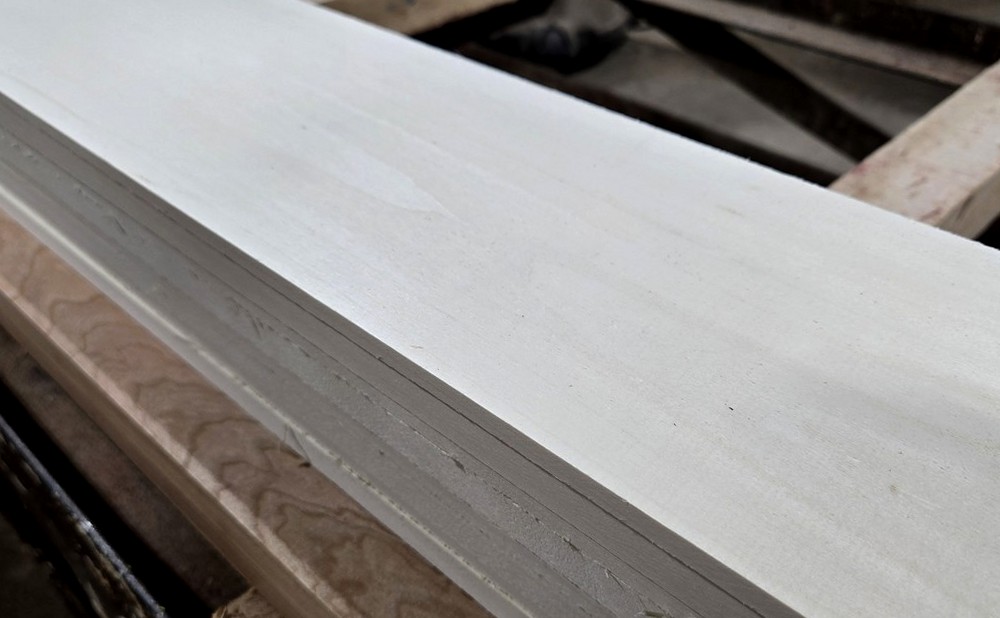 Face grain, board
 End grain, close-up