

Hardwood
Green Ash
Green ash (Fraxinus pennsylvanica) is a light to medium brown, shock-resistant hardwood from eastern North America, often sold as white ash and used for tool handles and flooring. This guide covers its Janka hardness, weight, shrinkage, rot resistance, workability and common uses.
Specs
Wood Name
Green Ash
Common Name(s)
Green ash. Sellers often mix it into white ash lots and sell it under the name white ash.
Scientific Name
Fraxinus pennsylvanica Marshall
Wood Type
Hardwood
Distribution
Green ash grows across eastern and central North America, according to The Wood Database. The Wood Handbook says it is one of the white ash group species that grow in the eastern half of the United States, including southern river bottoms.
Tree Size
The Wood Database lists 50 to 65 ft (15 to 20 m) tall with a trunk 12 to 24 in (0.3 to 0.6 m) across. We found no second source.
Average Dried Weight
The Wood Database lists 40 lbs/ft³ (640 kg/m³) at 12% MC. The Wood Handbook gives specific gravity only.Source: The Wood Database; USDA Wood Handbook
Specific Gravity (Basic, 12% MC)
The Wood Handbook lists 0.53 basic (oven-dry weight, green volume). The Wood Database lists 0.53 basic and 0.64 at 12% MC.Source: The Wood Database; USDA Wood Handbook
Janka Hardness
The Wood Handbook lists side hardness of 1,200 lbf (5,340 N) at 12% MC, and The Wood Database gives the same figure.Source: The Wood Database; USDA Wood Handbook
Modulus of Rupture
The Wood Handbook lists 14,100 psi (97.2 MPa) at 12% MC.Source: USDA Wood Handbook
Elastic Modulus
The Wood Handbook lists 1,660,000 psi (11,400 MPa) at 12% MC.Source: USDA Wood Handbook
Crushing Strength
The Wood Handbook lists 7,080 psi (48.8 MPa) parallel to grain at 12% MC.Source: USDA Wood Handbook
Shrinkage
Green to oven-dry, the Wood Handbook lists 4.6% radial, 7.1% tangential and 12.5% by volume. The tangential to radial ratio works out to 1.5.Source: USDA Wood Handbook
Description
Color/Appearance
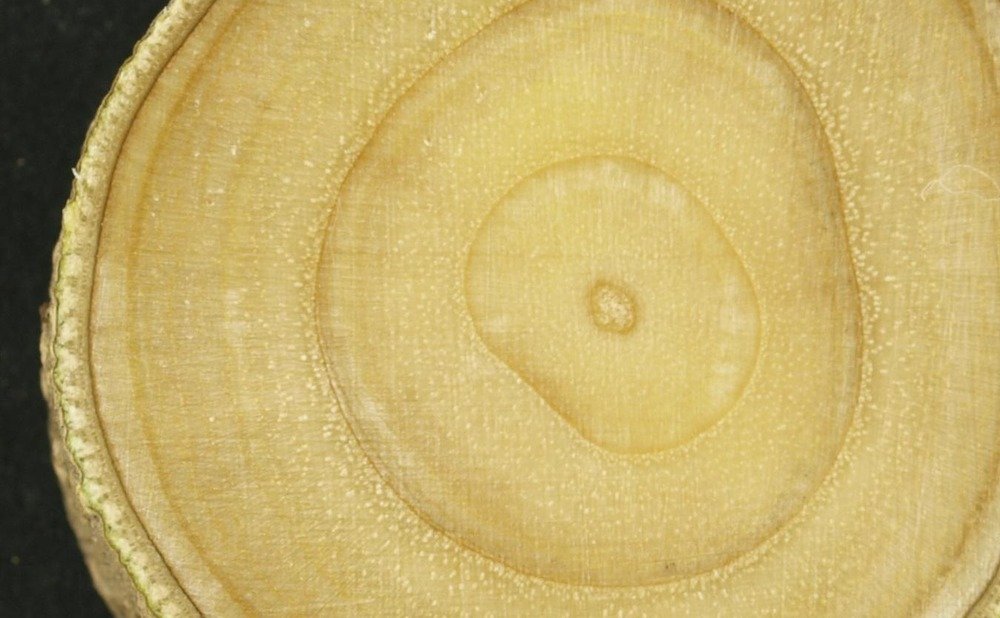
The heartwood is light to medium brown. The sapwood is broad and runs from beige to light brown, and the boundary with the heartwood can be hard to see.
Grain/Texture
Ash has a texture between medium and coarse that looks much like oak. The grain is usually straight and even, and an occasional board shows curl or figure. The Wood Handbook notes that green ash from long-flooded southern river bottoms can have buttresses with light, brash wood.
Rot Resistance
The Wood Handbook puts the ashes in its lowest decay-resistance group (slightly or nonresistant). The Wood Database rates the heartwood from perishable to slightly durable against decay and gives it no protection from insects.
Workability
The Wood Database reports good results with hand and machine tools. Ash steam bends well and takes glue, stain and finish without trouble.
Odor
The Wood Database says the wood gives off a noticeable, moderately unpleasant smell when cut or shaped.
Allergies/Toxicity
According to The Wood Database, reports link woods of the Fraxinus genus to skin irritation and reduced lung function. Health agencies treat all wood dust as a hazard, and it can irritate the nose, throat and skin. Wear a dust mask and use dust collection when you cut or sand it.
Pricing/Availability
The Wood Database places ash among the lowest-priced utility hardwoods in the United States, at a level close to oak. Prices are not quoted here.
Sustainability
IUCN rates Fraxinus pennsylvanica as Critically Endangered (assessed 2017). The emerald ash borer, an invasive beetle, is killing ash trees across North America and is behind the rating, and The Wood Database says green and black ash are the species it attacks first. CITES does not list green ash in the Appendices valid from March 5, 2026.
Common Uses
The Wood Database lists flooring, millwork, boxes and crates, baseball bats and turned items. It adds that, together with hickory, green ash is among the woods most often chosen for tool handles in North America, such as shovel and hammer handles, because it absorbs impact.
Sources
- USDA Forest Service, Wood Handbook (FPL-GTR-282), chapter 5, Tables 5-3a and 5-3b (strength of U.S. hardwoods), research.fs.usda.gov
- USDA Forest Service, Wood Handbook (FPL-GTR-282), chapter 4, Table 4-3a (shrinkage), research.fs.usda.gov
- USDA Forest Service, Wood Handbook (FPL-GTR-282), chapter 14, Table 14-1 (decay resistance groups), research.fs.usda.gov
- USDA Forest Service, Wood Handbook (FPL-GTR-282), chapter 2 (species notes on the ashes), research.fs.usda.gov
- IUCN Red List, Fraxinus pennsylvanica (2017), iucnredlist.org
- The Wood Database, green-ash page (secondary reference, used for cross-checks and gaps), wood-database.com
- CITES Appendices I, II and III valid from March 5, 2026, cites.org
- BfN CITES tree list, March 5, 2026 (pointer only; the Appendices above are the legal text), bfn.de
- CCOHS, Wood Dust – Health Effects (revised March 28, 2023), ccohs.ca
Photos
 End grain, stem